Restaurant loyalty programme: quick launch guide for UK restaurants
Restaurant loyalty programme: quick launch guide for UK restaurants

A simple, low-friction digital stamp or QR-code loyalty programme targeted at your best customer segments will deliver the fastest uplift in repeat visits. Start with a 30-day pilot today.
Here is the practical shortcut: set one clear reward (say, a free side after eight visits), create a single QR-code landing page, and promote it at the till, on receipts, and via any existing email list. No app. No hardware. No six-month IT project.
- Recommended starting model: digital stamp card with QR-code check-in, targeting high-frequency guests and birthday sign-ups.
- Pilot window: 30 days is enough to see enrolment rate, visit frequency lift, and early redemption data.
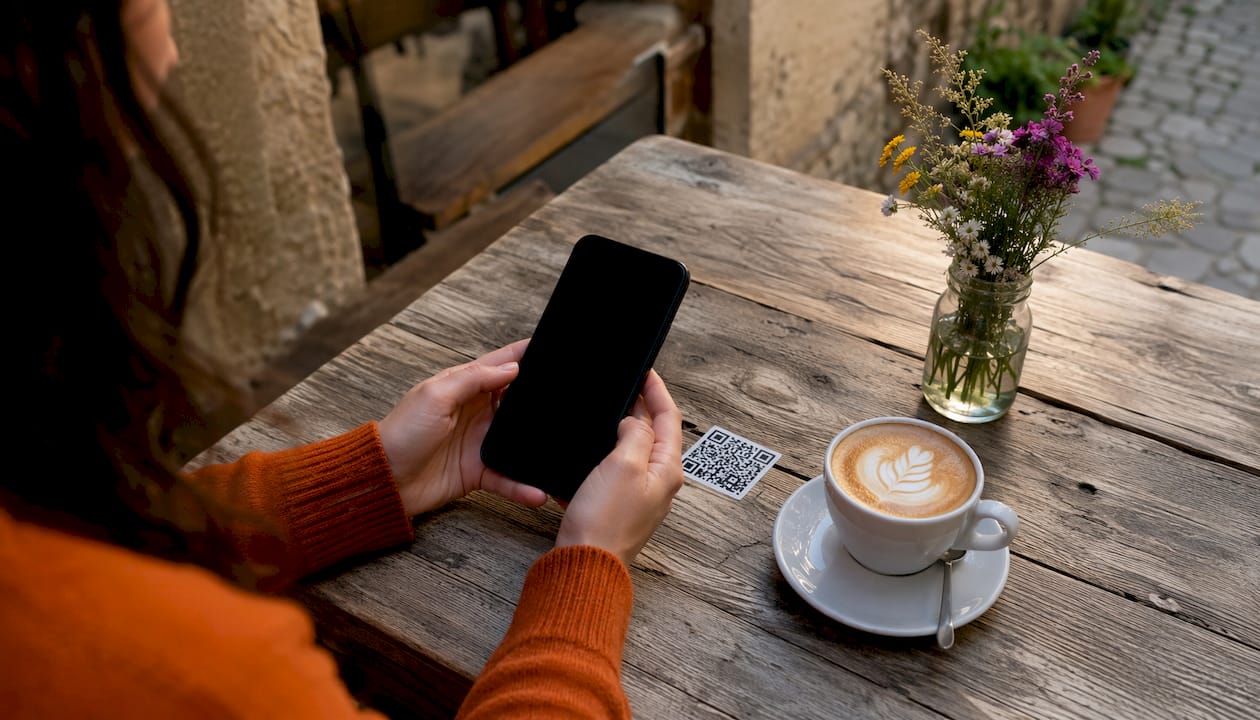
- Why QR onboarding wins: low-friction QR check-ins avoid app-download drop-off and immediately start building a first-party customer database you can market to directly.
- Immediate next step: pick your reward, set your stamp threshold, and get a QR code live in venue this week.
Pro Tip: Ask for a birthday at sign-up. A single automated birthday treat email costs almost nothing to send and consistently outperforms generic promotional blasts in open rate and redemption.
Table of Contents
- Why does a loyalty programme matter for your restaurant right now?
- What types of loyalty programme can restaurants run?
- What do the best loyalty programmes actually reward?
- How do you design and launch a restaurant loyalty programme?
- What UK-specific factors should you consider?
- How do you measure whether your loyalty programme is working?
- What mistakes do restaurants make with loyalty programmes?
- How do you choose the right loyalty platform for your restaurant?
- How does a Pintup stamp-card pilot actually work?
- What does a 30/60/90-day launch plan look like?
- Key takeaways
- What actually works for UK independents
- Pintup gets your restaurant loyalty programme live this week
- Useful sources and further reading
Why does a loyalty programme matter for your restaurant right now?
The core business case is straightforward: a customer who visits twice a week is worth many times more over a year than one who visits twice a month. A loyalty programme gives you the mechanics to shift people from the second group into the first, and the data to know whether it is working.
Loyalty members deliver higher visit frequency and spend, but only when the programme is designed with reward economics in mind. A poorly priced reward can cost more than the incremental revenue it generates, so the design stage matters as much as the launch.
Beyond frequency, a well-run programme builds a usable marketing database. Every sign-up is a consented contact you can reach with a slow-Tuesday offer, a birthday treat, or a new menu announcement. That list compounds in value over time in a way that a social media following simply does not, because you own the channel.
Key outcomes operators typically see from a well-run scheme:
- Higher average visit frequency among enrolled members versus non-members.
- Larger average transaction values, as members tend to add items to qualify for the next stamp.
- A growing first-party database for targeted re-engagement campaigns.
- Measurable customer lifetime value (CLV) uplift over a 90-day window.
New loyalty sign-ups increasingly include a large proportion of Gen Z, who favour mobile-first, low-friction flows. If your sign-up process involves a paper form or a clunky app download, you risk losing an important loyalty-active demographic before they even start.
The revenue maths are worth spelling out simply. If a member visits one extra time per month and spends a typical visit amount, that can result in significant incremental annual revenue from a single customer. Multiply that across many active members and the programme can pay for itself many times over, even after the cost of rewards.
What types of loyalty programme can restaurants run?
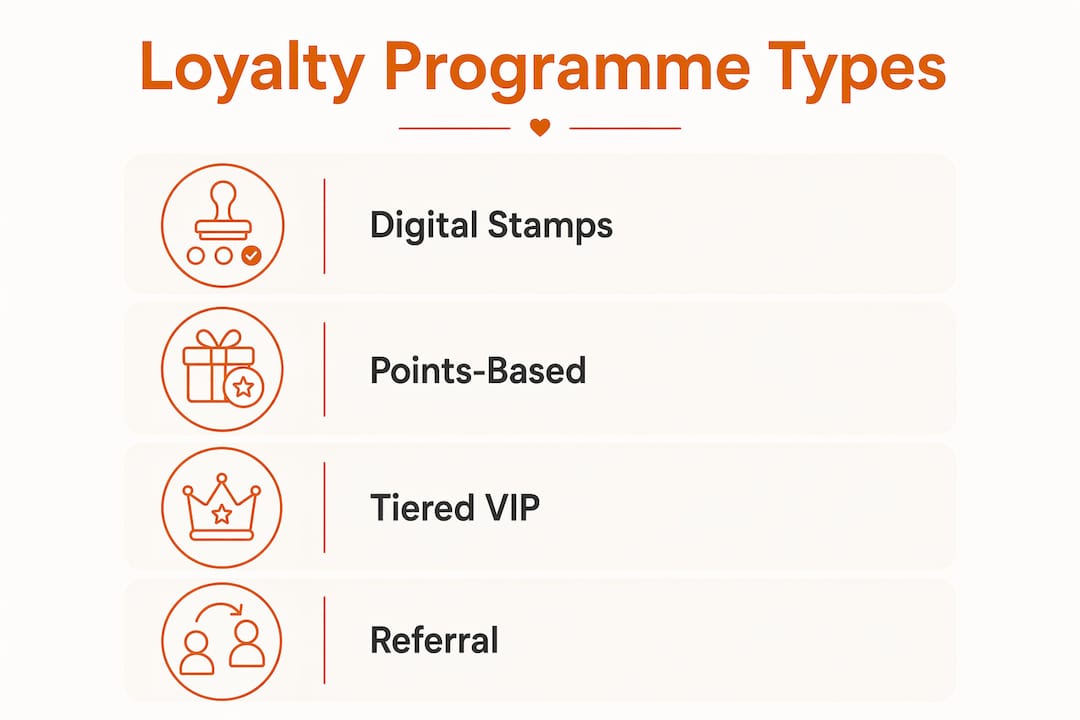
Loyalty programmes come in several distinct models, each with different complexity, margin impact, and operational demands. The right choice depends on your concept, average spend, and how much staff time you can realistically dedicate.
| Model | Best for | Operational complexity | Margin risk |
|---|---|---|---|
| Digital stamp card | Cafés, casual dining, high-frequency venues | Low | Low if threshold is set correctly |
| Points-based | Mid-range restaurants, delivery-led venues | Medium | Medium (requires careful point valuation) |
| Tiered VIP | High-ticket restaurants, members’ dining | High | Low (perks are often non-monetary) |
| Paid subscription | Concept-led venues, coffee specialists | Low to medium | Low (revenue upfront) |
| Referral programme | Any venue wanting new customer acquisition | Low | Low |
Digital stamp card (pay X, get Y): the simplest model and the fastest to launch. Customers collect a stamp per visit (or per spend threshold) and unlock a reward at a set number. Works brilliantly for cafés, lunch spots, and any venue with a regular weekday crowd. The main risk is setting the reward too generously relative to your margin, so map the break-even before you go live.
Points-based: customers earn points per pound spent and redeem against a menu of rewards. More flexible than a stamp card, but harder to explain at the till and more complex to administer. Better suited to mid-range restaurants where spend varies significantly between visits.
Tiered VIP: bronze, silver, gold tiers unlocked by cumulative spend or visits. The tiers themselves create aspiration and status, which means the rewards can be experiential (a chef’s table booking, early access to a new menu) rather than discounts. Suits high-ticket or destination restaurants where the guest relationship is already emotional.
Paid subscription: customers pay a monthly or annual fee for guaranteed perks (a free coffee daily, 10% off every visit). Works well for coffee-led concepts and neighbourhood restaurants with a loyal core. The upfront revenue is attractive, but you need enough regulars to make the proposition credible.
Referral programme: members share a unique link or code; successful referrals earn a reward for both parties. Low cost, low complexity, and a natural fit as a bolt-on to any of the above models rather than a standalone scheme.
- Small venues benefit most from simpler models that staff can explain in one sentence and customers can understand without reading terms and conditions.
- Avoid launching two models simultaneously. Pick one, run it for 90 days, then layer in complexity if the data supports it.
What do the best loyalty programmes actually reward?
The most instructive examples are not always the biggest. The mechanics that drive behaviour at Costa, Starbucks, and McDonald’s are directly copyable at a single-site restaurant, often with a fraction of the technology.
| Programme | Core mechanic | Key behaviour driver | Copyable for independents? |
|---|---|---|---|
| Costa Club | Points per £ spent, redeemable for drinks | Frequency and upsell | Yes — points per visit or spend |
| Starbucks Rewards | Stars per £, tiered status, personalised offers | Frequency, mobile order, personalisation | Yes — birthday treat, personalised reward |
| MyMcDonald’s | Points per order, surprise offers, app exclusives | Frequency, app adoption, upsell | Partially — surprise offers work without an app |
Costa Club rewards customers with points for every pound spent, redeemable against drinks and food. The mechanic is simple enough to explain in seconds, which is why uptake is high. For an independent café or restaurant, the equivalent is a points-per-visit or points-per-£-spent rule with a clear, desirable redemption. The key lesson: make the path to the first reward short enough that a new member reaches it within two or three visits.
Starbucks Rewards layers personalisation on top of a points base. Members receive offers tailored to their order history (double stars on your usual order, a free birthday drink of your choice). The birthday mechanic alone drives measurable visit spikes. An independent can replicate this with a single birthday field at sign-up and an automated email trigger, no app required.
MyMcDonald’s uses surprise offers and app-exclusive deals to drive both frequency and digital adoption. The surprise-and-delight element is the transferable insight: personalised surprise rewards build deeper engagement than a predictable points-to-discount mechanic, because they create an emotional response rather than a purely transactional one.
Concrete reward ideas any independent can use:
- Visit milestone: a free dessert or side on the fifth visit.
- Birthday treat: a complimentary starter or drink sent automatically in the member’s birthday month.
- Double-stamp Tuesday: extra stamps on a slow weekday to redistribute footfall.
- Surprise drop: an unannounced “you’ve earned a free coffee” message sent to members who haven’t visited in three weeks.
The last one is particularly effective because it feels personal rather than promotional, and it costs almost nothing to send.
How do you design and launch a restaurant loyalty programme?
Getting from idea to a live programme in 30 days is realistic. The steps below assume a digital stamp-card model, which is the fastest to configure and the easiest for staff to manage.
Phase 1: design decisions (days 1–7)
- Define your goal. Is the primary objective frequency, spend per visit, new customer acquisition, or reactivating lapsed guests? One goal per pilot.
- Set your reward economics. Map the break-even: if a free side costs you £3 and requires eight stamps, the customer must spend at least £X across those visits for the reward to be profitable. Run the numbers before you commit.
- Choose your stamp trigger. Per visit is simplest. Per £-spend threshold (e.g. one stamp per £10 spent) ties rewards more tightly to revenue but is slightly harder to explain.
- Decide on sign-up data. At minimum: name, email, birthday. These three fields are enough to run personalised re-engagement without overwhelming the customer at sign-up.
- Pick your platform. Criteria in the provider section below; for most independents, a QR-code-based platform with no hardware requirement is the right starting point.
Phase 2: operational setup (days 8–21)
- Configure your loyalty rules in the platform and test the full customer journey yourself before going live.
- Write a staff training script. Two sentences: what the programme is, and how to ask every customer to join. Clear staff scripts and visible signage are among the most reliable drivers of early enrolment.
- Place QR codes at the till, on tables, on receipts, and on any takeaway packaging.
- Set up email automations: a welcome message on sign-up, a birthday treat trigger, and a re-engagement message for members who haven’t visited in 28 days.
- Prepare in-venue promotion: a small A5 card or counter card explaining the programme in plain English.
Phase 3: launch and iterate (days 22–90)
- Announce to your existing email list and social followers on launch day.
- Brief staff again on day one of live trading. Enrolment rate in the first week is almost entirely a function of how consistently staff mention it.
- Review KPIs at day 30 (enrolment rate, active member rate, redemption rate). Decide whether to scale or adjust.
Rough cost estimate: a QR-based digital loyalty platform for a single site typically costs £20–£50 per month in the UK. Staff training takes two to three hours. Total time-to-live for a simple stamp card is under one working day once the platform is chosen.
What UK-specific factors should you consider?
UK diners are convenience-driven. The single biggest barrier to loyalty sign-up in the UK market is friction: if joining takes more than 30 seconds, a meaningful proportion of customers simply will not bother. QR-code onboarding, which opens a mobile browser page rather than requiring an app download, removes that barrier almost entirely.
Gen Z now accounts for close to half of new loyalty sign-ups, and they expect the experience to be mobile-native. A paper stamp card will not engage this cohort. A QR code that resolves instantly on any smartphone will.
GDPR practical checklist for UK operators:
- Collect only the data you will actually use (name, email, birthday is sufficient for most programmes).
- State clearly at sign-up what you will send and how often.
- Use a double opt-in or a clear single opt-in with an unchecked marketing consent box.
- Store data on a platform that is UK/EU GDPR-compliant and can export or delete a customer record on request.
- Set a data retention policy: if a member has not engaged in 24 months, either re-permission them or delete their record.
- Keep a record of when and how consent was obtained.
The ICO (Information Commissioner’s Office) publishes free guidance on direct marketing consent that is worth reading before you launch. This article is general information, not legal advice; confirm your specific data practices with a qualified professional or the ICO’s own resources.
Pro Tip: Run a double-stamp promotion on your quietest weekday for the first four weeks after launch. It costs nothing extra in reward liability (members still need to reach the full threshold) but it visibly rewards members for changing their behaviour, which accelerates habit formation.
UK cultural preferences lean towards tangible food-and-drink rewards over percentage discounts. A free coffee or a complimentary side feels more generous than “5% off your next visit” even when the monetary value is identical or lower. Frame rewards in product terms, not discount terms.
How do you measure whether your loyalty programme is working?
Tracking the right numbers from week one prevents you from running a programme for six months before realising it is not moving the needle.

| KPI | Formula | Pilot target (30 days) |
|---|---|---|
| Enrolment rate | — | 10–20% of covers |
| Active member rate | — | 40–60% |
| Visit frequency lift | Avg visits/member (post) vs avg visits/member (pre) | Positive trend |
| Redemption rate | — | 15–30% |
| Incremental revenue per member | Revenue from members vs matched non-member cohort | Positive delta |
| CLV uplift | Avg member spend over 90 days vs non-member baseline | Measurable by day 60 |
| Churn rate | — | Below 30% |
A few points on interpreting early signals. Enrolment rate in week one is almost entirely driven by staff behaviour, not the programme design. If it is below 5%, the problem is the ask at the till, not the reward. Redemption rate below 10% usually means the reward threshold is too high or the reward itself is not compelling. An active member rate above 50% at day 30 is a strong signal that the programme is worth scaling.
The primary goal is converting first-time diners into repeat guests and building a database for targeted marketing. Track frequency lift as the single most important metric: it is the number that translates most directly into revenue.
Weekly tracking for a 30-day pilot:
- Week 1: enrolment rate, total sign-ups, staff compliance (are they asking every customer?).
- Week 2: active member rate, first repeat visits from enrolled members.
- Week 3: redemption rate, any email open/click rates from automated messages.
- Week 4: full KPI review against the table above; go/no-go decision on scaling.
What mistakes do restaurants make with loyalty programmes?
Most loyalty programmes that fail do so for the same handful of reasons, and nearly all of them are avoidable at the design stage.
Common pitfalls:
- Overcomplicating the rules. If a customer cannot explain how the programme works to a friend in one sentence, the rules are too complex. Complexity kills uptake.
- Poor staff onboarding. A programme that staff do not mention does not exist. The single most common reason for low enrolment is that the team forgot to ask, not that customers were uninterested.
- Unclear reward fulfilment. If staff are unsure how to redeem a reward at the till, the customer experience breaks down at the exact moment it should feel rewarding.
- Ignoring inactive members. A lapsed member is a warm lead, not a lost cause. An automated re-engagement email sent at 28 days of inactivity costs nothing and regularly brings people back.
- Expensive per-redemption rewards. A free main course as the first reward is generous but can erode margin quickly. A free side, a complimentary drink, or a small discount is usually sufficient to feel valuable while remaining profitable.
Best practices that consistently produce results:
- Keep the stamp threshold achievable within two to three weeks of normal visit frequency.
- Use zero-party data — preferences and birthdays volunteered at sign-up — to personalise offers rather than relying solely on purchase history.
- Automate re-engagement triggers so the programme works without manual effort between visits.
- Gamify modestly: a “you’re two stamps away from your reward” nudge in an email is enough to drive a visit without feeling manipulative.
Pro Tip: Cap your outstanding reward liability by setting a redemption window. A reward earned but not redeemed within 90 days expires. State this clearly at sign-up. It protects your margin and creates a gentle urgency that actually increases redemption rates rather than reducing them.
How do you choose the right loyalty platform for your restaurant?
The platform decision is mostly about removing friction from three directions: the customer joining, the staff operating it, and you reading the data.
Must-have criteria:
- QR-code onboarding with no app download required for the customer.
- Staff can issue stamps from any device without dedicated hardware or EPOS integration.
- Real-time reporting dashboard accessible from a phone or laptop.
- Exportable customer data (CSV at minimum) so you own your list.
- Automated email triggers (welcome, birthday, re-engagement) built in.
- Transparent per-site pricing with a free trial period.
Integration checklist:
| Feature | Required for pilot? | Required to scale? |
|---|---|---|
| POS sync | No | Useful |
| Mobile wallet passes | No | Nice to have |
| CSV import/export | Yes | Yes |
| Dedicated hardware | No | No |
| SMS triggers | No | Useful |
| API access | No | Depends on tech stack |
Omnichannel features like POS sync and mobile wallet passes help at scale, but they are not required for a local repeat-visit pilot. Adding integration complexity before you have validated the programme’s core mechanics is a common mistake that delays launch by weeks.
Commercial terms to check:
- Does the trial give you enough time (ideally 14–30 days) to see real enrolment data?
- Who owns the customer data if you leave the platform?
- Is there a minimum contract term or a rolling monthly subscription?
- What onboarding support is included?
Red flags: platforms that lock customer data behind an export fee, require proprietary hardware, or charge per-redemption rather than a flat monthly fee. Per-redemption pricing creates a perverse incentive to suppress redemptions, which is the opposite of what a good loyalty programme should do.
How does a Pintup stamp-card pilot actually work?
Pintup is built specifically for independent hospitality venues: pubs, cafés, restaurants, and bars. The core mechanic is a fully branded digital stamp card that customers access by scanning a QR code on their phone. No app download. No EPOS integration. No hardware.
Here is the step-by-step pilot path:
- Sign up and configure your card. Set your brand colours, upload your logo, choose your stamp threshold (e.g. eight stamps for a free side), and write your reward description. This takes under 30 minutes.
- Place your QR codes. Print and display at the till, on tables, on receipts, and on any takeaway bags. Pintup provides print-ready assets.
- Brief your team. The staff script is two sentences: “We have a loyalty card — scan this QR code to join and start collecting stamps today.” That is it.
- Activate email automations. Set the welcome email, the birthday treat trigger, and the 28-day re-engagement message. These run automatically from the moment a customer signs up.
- Monitor the dashboard. Real-time reporting shows enrolment, active members, stamp velocity, and redemptions. Check it weekly during the pilot.
Expected metrics for a 30-day pilot with Pintup:
- Enrolment rate of 10–20% of covers when staff consistently ask every customer.
- A growing email list you can use for future campaigns, menu launches, and event promotions.
- First redemptions typically appearing in weeks two to three, confirming the reward threshold is calibrated correctly.
- Birthday email open rates significantly above standard promotional email benchmarks, because the message is personally relevant.
Pro Tip: Use Pintup’s referral link feature from day one. Give enrolled members a shareable link that earns them a bonus stamp when a friend signs up. It costs you nothing until the friend visits, and it turns your most loyal customers into your most effective acquisition channel.
Pintup’s restaurant loyalty programme page walks through the full feature set with venue-specific examples. For cafés, the digital coffee stamp card setup is particularly quick to configure.
What does a 30/60/90-day launch plan look like?
The verdict is simple: start with the lowest-friction model available, measure the three or four KPIs that matter, and iterate based on data rather than instinct.
30/60/90-day action plan:
- Days 1–7 (owner): choose platform, set reward economics, configure stamp card, brief staff.
- Days 8–14 (owner + front-of-house manager): go live, place QR codes, activate email automations, announce to existing contacts.
- Days 15–30 (front-of-house manager): monitor enrolment rate weekly; coach any staff member whose section shows low uptake.
- Day 30 (owner): full KPI review. Go/no-go decision: if enrolment rate exceeds 10% and active member rate exceeds 40%, proceed to scale.
- Days 31–60 (owner): add a referral mechanic, run a double-stamp promotion on the slowest weekday, send first targeted email campaign to the member list.
- Days 61–90 (owner): review CLV data for the first cohort, test a second reward tier or a birthday-specific offer, and assess whether POS integration would add meaningful value.
Go/no-go thresholds at day 30:
- Enrolment rate above 10%: continue and scale.
- Active member rate above 40%: the reward is working; maintain the threshold.
- Redemption rate below 5%: the reward threshold is too high or the reward is not compelling; adjust before month two.
- Enrolment rate below 5%: the problem is staff behaviour, not the programme; retrain and relaunch.
The 90-day window is enough to see meaningful CLV data for your first cohort and to make a confident decision about whether to invest further.
Key takeaways
A digital QR-code stamp card is the fastest, lowest-risk way for a UK restaurant to launch a loyalty programme, build a first-party customer database, and drive measurable repeat visits within 30 days.
| Point | Details |
|---|---|
| Start with QR stamp cards | Low-friction QR onboarding removes app-download barriers and builds a first-party email list from day one. |
| Birthday data is your highest-ROI field | Collecting a birthday at sign-up enables automated treat emails that consistently outperform generic promotions. |
| Staff behaviour drives enrolment | Enrolment rate in week one reflects how consistently staff ask, not how good the reward is. |
| Track frequency lift above all else | Visit frequency lift translates most directly into revenue; target a positive trend by day 30. |
| Pintup for independent venues | Pintup lets UK restaurants launch a fully branded stamp-card programme with no app or hardware, on a monthly subscription. |
What actually works for UK independents
The conventional wisdom on loyalty programmes tends to overstate the importance of technology and understate the importance of the ask. Most independent operators who struggle with enrolment are not failing because their platform is wrong. They are failing because nobody at the till is mentioning the programme.
The single change that produces the most outsized gain, consistently, is making the loyalty ask part of the payment ritual. Not a poster on the wall. Not a flyer on the table. The person taking payment saying, “Have you got our loyalty card? Scan this and you’ll get a free [X] after eight visits.” That one behavioural change, done consistently across every shift, can move enrolment from 2% of covers to 15% within a fortnight.
The second underrated mechanic is the double-stamp slow day. Running double stamps on a Tuesday or Wednesday costs nothing in additional reward liability (members still need to reach the full threshold) but it visibly rewards members for visiting on a day they might not have chosen. Over time, it reshapes visit patterns in a way that benefits both the business and the customer.
Independent venues have one genuine advantage over chains: they can be personal in a way that a national brand structurally cannot. A handwritten note on a birthday reward email, a staff member who remembers a regular’s usual order, a surprise “we haven’t seen you in a while, here’s a free coffee” message. These moments cost almost nothing and build the kind of affinity that no points balance can replicate. Surprise-and-delight offers build emotional loyalty that goes well beyond the transactional repeat visit.
The gap between what loyalty programmes promise and what they actually deliver is almost always a gap in execution, not in technology. The technology is the easy part.
Pintup gets your restaurant loyalty programme live this week
Most restaurant owners spend longer researching loyalty platforms than it takes to actually launch one. Pintup is built to close that gap: a fully branded digital stamp card, live in under an hour, with no app for your customers to download, no hardware to install, and no EPOS integration required.
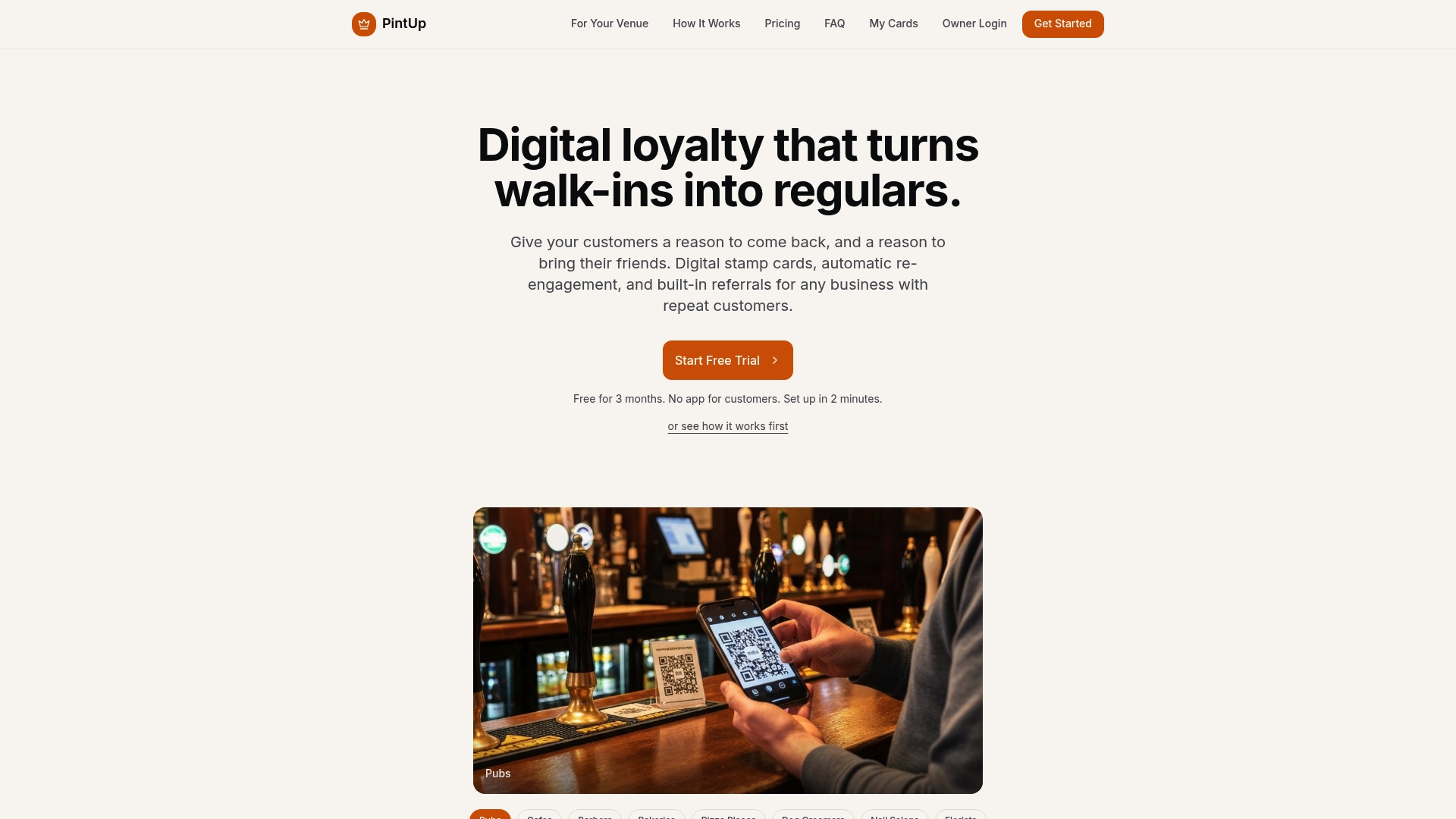
Customers scan a QR code at the till, join your programme in seconds, and start collecting stamps immediately. You get a real-time dashboard showing enrolment, active members, and redemptions, plus automated emails for welcome messages, birthday treats, and re-engagement nudges that run without any manual effort. Every member becomes a contactable customer on a list you own outright.
Pricing is a straightforward monthly subscription per location, with a free trial so you can see real enrolment data before you commit. There are no per-redemption fees and no lock-in contracts.
Start your free trial today, or visit the restaurant loyalty page to see how the programme works for venues like yours.
Useful sources and further reading
- Restaurant loyalty strategy in 2026: why personalisation decides the winners — practical analysis of why personalised re-engagement now outperforms generic offers, with strategic framing for 2026.
- Gen Z is taking over restaurant loyalty programme sign-ups — data on Gen Z as the dominant new loyalty cohort and what their mobile-first preferences mean for programme design.
- Restaurant loyalty programmes (Deloitte) — industry-level analysis of loyalty ROI, reward economics, and the conditions under which programmes are genuinely profitable.
- How to build customer loyalty programmes (Mastercard) — authoritative guide to zero-party data collection and personalisation mechanics.
- Top QR-code loyalty programmes for cafés and restaurants — practical overview of QR-based onboarding approaches and why they outperform app-based alternatives for hospitality.
- Customer loyalty programmes: types, mechanics and success stories (Zendesk) — covers staff training, launch messaging, and the operational basics of getting a programme off the ground.
- ICO direct marketing guidance — the UK’s official regulator guidance on consent and direct marketing; essential reading before collecting customer emails.
- Pintup restaurant loyalty programme — venue-specific features, reward configuration options, and expected outcomes for UK restaurant operators.